








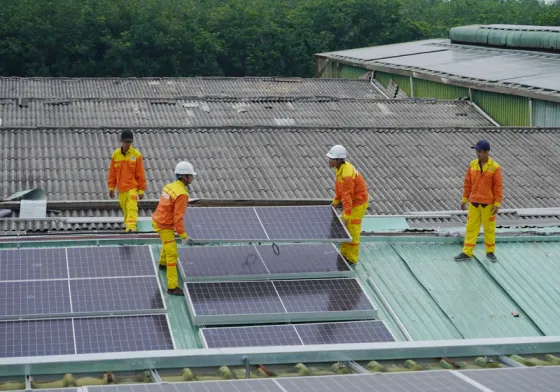

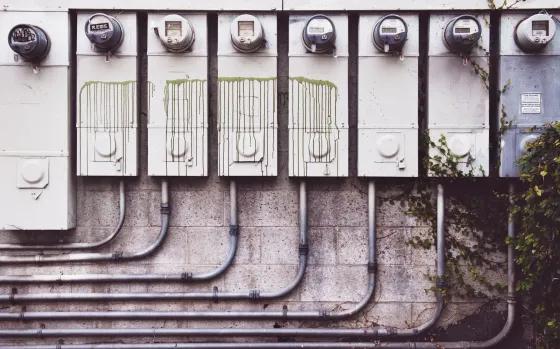







If you’re on Arizona Public Service or Unisource and your panels are already wired to the grid, nothing changed for you today. Your interconnection request locked your export rate the day it was filed, and it stays there. File this away.
Everybody else in those two territories: the number your installer built the payback quote around dropped this morning.
As of September 1, APS and UNS credit you $0.05554 for every kilowatt-hour your roof pushes back onto the grid. It was $0.06171. The Arizona Corporation Commission voted that 10% cut through on August 13.
Seven years, seven cuts, all at the legal maximum
Arizona law caps how fast the export rate can fall at 10% a year.
APS didn’t ask for 10%. It asked for 36.8%, all the way down to $0.04511. The commission said no and handed it the legal maximum instead.
That’s the seventh year running Arizona has taken the biggest cut the statute allows, every year since 2018 except 2022. The rate was $0.129 in 2018. It’s $0.0555 now. Down 56.9% in eight years.
Kate Bowman of Vote Solar, which fought the reduction: “We are disappointed by the ACC’s decision to discourage solar adoption, keeping meaningful relief for customers and communities out of reach.”
Now the part nobody says out loud at the hearing. By Vote Solar’s own numbers, an APS customer pays about 34 cents a kilowatt-hour on a summer evening. A UNS customer pays about 19 cents. You sell at 5.55.
Same wire, same afternoon, roughly six to one.
What it costs on your roof
Take 1,000 kilowatt-hours of exports a year. This year’s cut alone shaves $6.17 off what you collect. Sounds like nothing, and for one year it is.
It isn’t one year. Your credit doesn’t reset annually, it attaches to your interconnection request and sits there.
Stack all eight years of cuts and the picture sharpens. Those same 1,000 exported kilowatt-hours earned $129 in 2018. Today they earn $55.54.
The verdict: panels are still fine math in Arizona. Exporting isn’t. A kilowatt-hour you burn inside your own house is worth whatever APS would have charged you for it, up to about 34 cents on an August evening. The one you ship to the grid is worth a nickel and a half.
Do this before you sign
Have a signed solar contract in APS or UNS territory but no interconnection application filed yet? Call your installer today and ask, in writing, which export rate the application will get.
Then make them rebuild the payback at $0.05554. If the case still holds, sign it. If the whole thing leaned on 6.17 cents, you just learned what that quote was made of.
Tucson Electric Power customers, you’re next in line. The commission is set to take up the same reduction for TEP. An application in before that vote gets the rate that exists today.
Run the numbers yourself instead of taking the sales sheet on faith. Our solar payback calculator lets you set the export credit and see what changes when more of your production stays home. Size the array to what you burn in the evening, not to what fits on the roof. The rest of our solar coverage is in the solar hub and our current picks.
One piece of background worth having. Arizona doesn’t do one-for-one net metering anymore. It sets an export credit through a formula the commission calls the resource comparison proxy, recalculated every year and limited by that 10% cap. So this isn’t a one-time event. Barring a change in the law, there’s another cut queued up for next September.
How Candid Yak makes money. Some of the products we write about pay us if you apply or sign up through our links. That never changes our verdict, our rankings, or the numbers in this article. We call a bad deal a bad deal whether it pays us or not. Some brands shown in our comparison tools are placeholder examples while we finalize partner agreements, and we label them as such.
Sources
- ACC cuts Arizona solar export rate by 10% to 5.5 cents per kilowatt-hour (PV Tech)
- Arizona cuts rooftop solar export rate for seventh straight year, shrinking homeowner credits (The Cool Down, August 25, 2026)
- ACC Votes to Lower Solar Export Rate, Undervaluing Solar and Failing to Support Arizona's Growing Energy Needs (Vote Solar, August 13, 2026)