






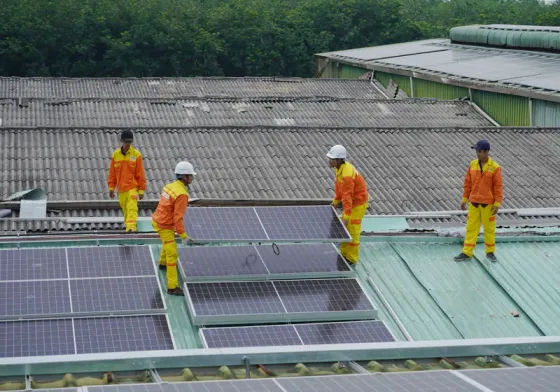




If you own a home in New York and your household counts as low or moderate income, there’s new state money for rooftop solar. The state’s affordable solar program has drawn that line at 80% of your area’s median income. Run the math before a salesperson runs it for you.
On October 14, NYSERDA, the state energy agency, put about $20 million toward roughly 40 megawatts of solar on low- and moderate-income homes. It says that’s enough for 6,500 homes. Divide it out and you get about $3,077 a house, on a system of about 6.2 kW. That’s roughly 50 cents a watt.
That’s real money. It’s also less than half of what the federal government stopped paying on January 1.
The credit that left
The federal Residential Clean Energy Credit covered 30% of the cost. The IRS says it isn’t available for anything placed in service after December 31, 2025.
Berkeley Lab’s latest data put New York’s median 2025 price for a home system you own at $3.90 a watt, before incentives. On 6,150 watts, that’s about $24,000. Thirty percent of that was about $7,200.
So the new state money covers roughly 13% of a typical New York price. The old credit covered 30%. Any quote built on last year’s math is now a $4,000 problem.
The money goes to the installer
NYSERDA says the funding starts going out “in the coming weeks,” with incentives “paid when projects are completed.” You don’t get a check. Cornell Cooperative Extension in Tompkins County, which explains the program to local homeowners, says the rebate “is taken directly off the up-front cost of the system.”
Here’s the catch. If the installer’s price drifts up by about the same amount, the discount is just a number on a brochure. Cornell listed the affordable rebate at $0.80 a watt as of December 2025. NYSERDA’s release doesn’t give the new rate. Make the installer put it in writing.
The state credit has fine print
New York still has its own credit: 25% of equipment costs, capped at $5,000. On a $24,000 system you’d hit the cap.
The tax department says it’s “not refundable.” It can only cancel New York income tax you actually owe, and leftover credit carries forward for up to five years. If your state tax bill is small, part of that $5,000 may never reach you. A salesperson who subtracts the full $5,000 from your price on day one is counting money you may not get.
What to do
Check your county’s income limit first, and confirm the current line with the installer or NYSERDA. Every county is different. Cornell’s example for Tompkins County was $102,240 for a family of four, as of December 2025.
Get at least three written quotes. Ask each installer which NY-Sun incentive you’re getting, how many cents a watt it is, and where it sits on the contract. Then divide the price before incentives by the system size in watts. Near $3.90 is New York’s median. Our installer price breakdown shows how far apart quotes can land.
Pull last year’s New York return and find the state tax you actually owed. Then plug the system price, the incentive and only the credit you can really use into our solar calculator. Compare offers on our best solar companies page, or start at the solar hub.
Worth a quote if you qualify. Not worth signing on a price that only pencils out with a federal credit that’s gone.
The rest of the $200 million
The $20 million is one slice. NYSERDA’s framework also includes about $116 million for large commercial and community solar, $31 million for midsize rooftop projects, and $33 million it can move to wherever demand is strongest. The community solar slice expands Statewide Solar for All, which NYSERDA says “delivers bill savings directly” to low- and moderate-income households, with no panels on your roof.
How Candid Yak makes money. Some of the products we write about pay us if you apply or sign up through our links. That never changes our verdict, our rankings, or the numbers in this article. We call a bad deal a bad deal whether it pays us or not. Some brands shown in our comparison tools are placeholder examples while we finalize partner agreements, and we label them as such.
Sources
- Deployment Framework Announced for $200 Million to Expand Affordable Solar (NYSERDA, October 14, 2026)
- Residential Clean Energy Credit (IRS)
- Solar energy system equipment credit (New York State Department of Taxation and Finance)
- U.S. Distributed Solar and Storage, 2026 Data Update, summary slides (Lawrence Berkeley National Laboratory, August 2026)
- Affordable Solar (Cornell Cooperative Extension Tompkins County)